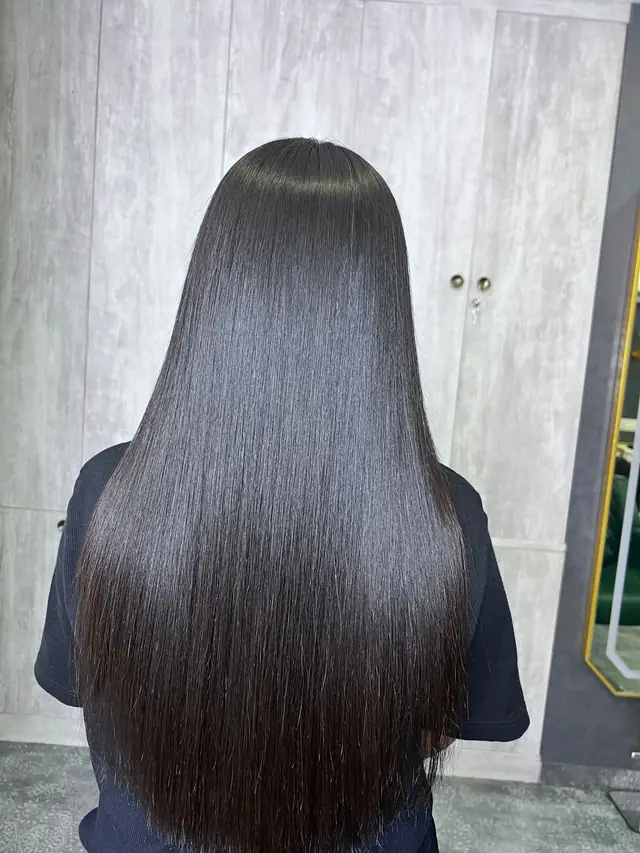
First, Is It Breakage or Hair Fall?
These two get mixed up all the time, and they need very different responses. Breakage happens along the hair strand — the hair snaps somewhere in the middle or near the ends. Hair fall (shedding) means the whole hair has come out from the root.
Pick up a few of the hairs you are finding and look closely:
| What you see | Breakage | Hair fall from the root |
|---|---|---|
| The end of the hair | Blunt, frayed or split — no bulb | A tiny white or pale bulb at one end |
| Length | Short pieces of different lengths | Full-length strands |
| Where it shows | Frizzy short bits along the lengths, thinner ends | More hair in the drain or comb, a wider parting |
Breakage is a hair-shaft problem, and good aftercare and trims can help. Hair fall from the root is a scalp and body question, and that belongs with a dermatologist — more on that below.
What Actually Causes Hair Breakage After Smoothening
Smoothening permanently changes the internal bonds of the hair and uses a flat iron to set the result. Done carefully on hair that can handle it, that is manageable. Breakage usually comes from one or more of these:
1. Damage that was already there
Hair that has been bleached, coloured many times, or heat-styled daily for years is already weaker. Smoothening on top of that can push it past its limit. This is why the consultation and strand test matter so much — sometimes the honest answer is to repair first and smoothen later, or not at all.
2. Over-processing
A formula that is too strong for your hair type, product left on too long, an iron that is too hot, or too many passes over the same section can all weaken the hair. Fine hair and lightened hair need a gentler approach than thick, coarse hair.
3. Overlapping re-treatments
When you come back for a touch-up, only the new growth at the roots should be treated. If the chemical is applied again over lengths that were already smoothened, those lengths get processed twice. Over repeated sessions, that overlap is one of the most common reasons I see a clear line of breakage partway down the hair.
4. Heat afterwards
Smoothened hair does not need a daily straightener. Using one at high heat, without protection, on hair that is already chemically treated wears it down quickly.
5. Tight ties, clips and rough handling
Tight rubber bands, the same ponytail spot every day, metal clips, sleeping on wet hair, rubbing with a towel and brushing hard while wet all cause friction and snapping. Treated hair is more fragile, especially when wet.
Honest note: if your hair is breaking badly, it is not always the treatment and it is not always the aftercare. Often it is a mix. The useful question is not whose fault it is, but what your hair needs now to stop it getting worse.
Your Week-by-Week Aftercare Plan
This is the general plan I give clients after smoothening. Your stylist's specific instructions always come first, because different products have different rules.
The first few days
Follow the no-wash period your stylist gives you — often two to three days. Keep hair loose and straight: no ties, clips, hair bands or tucking behind the ears. Avoid getting it wet in the rain or sweating heavily. Sleep on a smooth pillowcase.
Rest of week one
Start with a sulphate-free shampoo and the conditioner or mask recommended for your treatment. Use lukewarm water. Pat dry, then dry with a cool or warm setting — not hot. If you must tie hair, use a soft scrunchie and keep it loose.
Weeks two to four
Add a deep-conditioning mask once a week. Use a heat protectant before any styling tool and keep the temperature low. A light oil or serum on the ends is fine — gently, not heavy. Detangle with a wide-tooth comb from the ends upwards.
Month two onwards
Keep the sulphate-free routine. Plan a trim every few months to remove split ends before they travel up the strand. If your hair feels dry or rough, book a hair spa or a repair treatment such as Olaplex rather than reaching for more heat.
Before your next touch-up
Wait until you have enough new growth for a root-only application, and tell your stylist about any colour, home treatments or breakage since your last visit. Do not book any other chemical service in between without mentioning it.
If Your Hair Is Already Breaking
Stop adding stress to it and give it time. What helps:
- Put the straightener away for a few weeks, or use it only on the lowest setting with protection.
- Trim the most damaged ends. Split ends cannot be glued back together. Cutting them stops them splitting further up.
- Do not book another chemical service — no colour, no fresh smoothening — until a professional has checked your hair.
- Book a repair treatment. Olaplex, Hair Botox or a hair spa can improve how the hair feels and handles. None of them brings broken hair back, but they help the hair you have hold up better.
- Loosen your hairstyles. Change your ponytail position, use soft scrunchies and avoid metal clips.
If you are still deciding what to do next, my guide on hair smoothening vs keratin vs Hair Botox explains which treatments are gentler and which suit hair that needs repair first. If your hair is also coloured, the routine in my colour-treated hair care guide works well alongside this one.
When to See a Dermatologist
Salon treatments care for the hair shaft. They do not treat the scalp or the reasons hair falls out from the root. Please see a dermatologist if you notice:
- Hair coming out from the root in noticeably larger amounts than usual
- A widening parting, thinning patches or bald spots
- Itching, burning, redness, flaking, sores or pain on the scalp — especially after a chemical service
- Shedding that continues for weeks, or that started after an illness, pregnancy, a big change in diet or a stressful period
Hair fall can have many causes, and a doctor can check things a salon cannot. If you have a scalp reaction after any treatment, tell us too — we need to know before your next appointment.
At Popyz, every smoothening starts with a consultation, patch test and strand test. If a strand test shows your hair is not ready, we will say so and suggest repair first. Sometimes the kindest thing a stylist can do is say no for now.
Hair Smoothening and Repair at Popyz Beauty Lounge, Kozhikode
At our salon on Gandhi Road, we offer hair smoothening, Hair Botox, Olaplex hair repair, biotin hair treatment and hair spa, using professional brands including L'Oréal Professionnel, Schwarzkopf, Wella and Olaplex. You can see the full list on our hair services page.
If you are dealing with breakage after a smoothening — whether it was done with us or elsewhere — bring your hair in or get in touch. We will look at it honestly and tell you what it needs, even if that means waiting.
Frequently Asked Questions
Want Popy to look at your hair in person? Request an appointment or read about the service at Popyz.